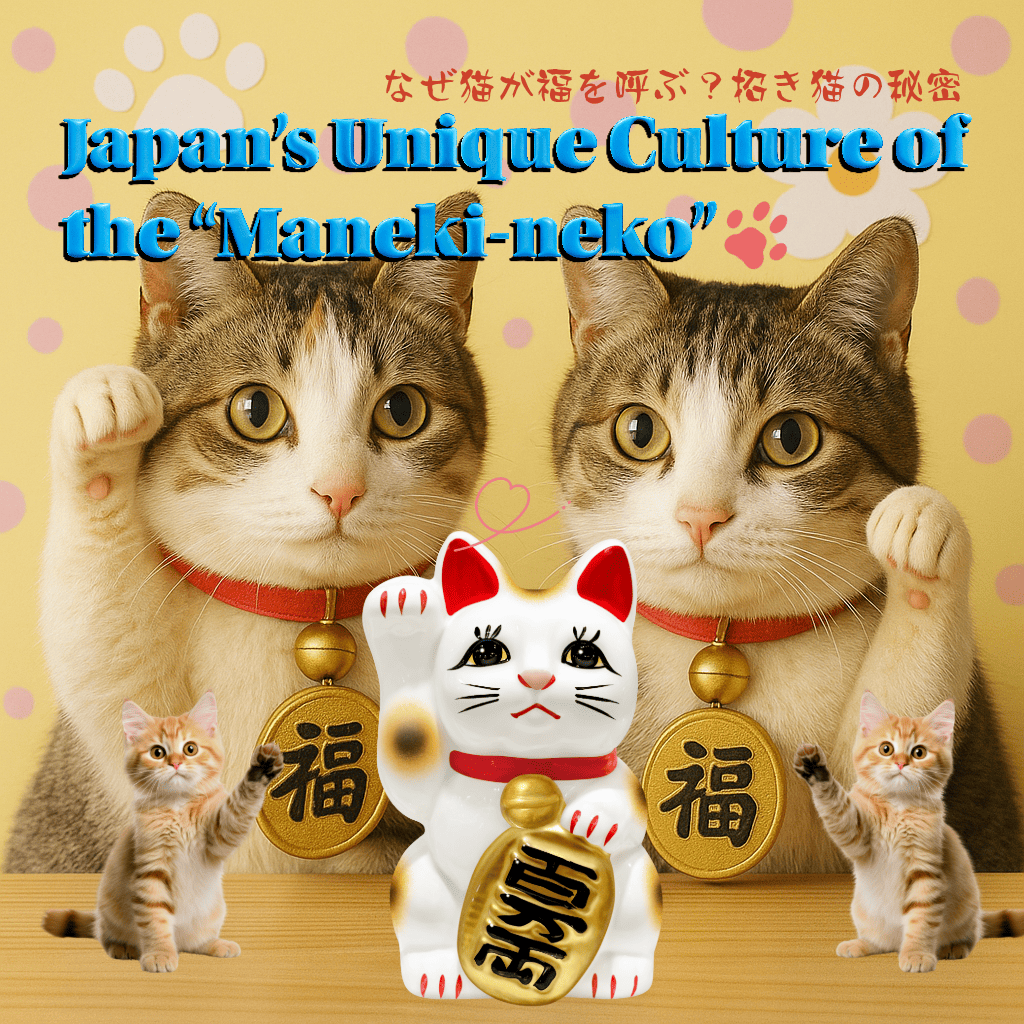
You’ve probably seen them at the entrance of shops, restaurants, or even temples in Japan: the Maneki-Neko, or “beckoning cat.” With one paw raised as if waving someone over, this figure is one of Japan’s most iconic lucky charms.
But why did cats come to be seen as symbols of good fortune? And did you know that there’s a difference in meaning between a Maneki-Neko raising its right paw and one raising its left?
In this article, we’ll dive into the history, cultural background, and hidden meanings behind the Maneki-Neko.
Reason 1: Guardians Against Mice In ancient times, cats were valued for their ability to protect rice harvests and silkworms by hunting mice. As “protectors of wealth,” they naturally came to be associated with prosperity.
Reason 2: A Gesture That Looks Like Beckoning When cats wash their faces with their front paws, it resembles a beckoning motion. Over time, people began to believe that cats could literally “invite people and fortune.”
Reason 3: Belief in Their Mysterious Eyes Cats’ eyes shine in the dark, and they move easily at night. This gave rise to the idea that cats had the power to “see ahead” and protect people from misfortune.
The Gotokuji Legend (Setagaya, Tokyo) It is said that Ii Naotaka, a feudal lord of Hikone, once took shelter in Gotokuji Temple after a cat beckoned him inside during a thunderstorm. Soon after he entered, lightning struck where he had been standing. Grateful, he became a patron of the temple, which prospered and enshrined the cat as a bringer of luck.
The Imado Pottery Theory (Asakusa, Tokyo) In Asakusa, clay figurines known as Imado-yaki cats were produced as lucky charms and quickly became popular among Edo townspeople.
Other Theories Some say that courtesans or merchants displayed cat figurines in hopes of “attracting more customers,” giving rise to the Maneki-Neko tradition.
✋ The Meaning of the Right and Left Paw
The most distinctive feature of the Maneki-Neko is that its meaning changes depending on which paw is raised:
Right paw raised → Attracts money and good fortune
Left paw raised → Attracts customers and people
Both paws raised → Invites both wealth and customers (though some say it looks greedy!)
Colors also carry different meanings:
White → Happiness and purity
Black → Protection against evil
Gold → Wealth and prosperity
Pink → Love and romance
📖 Source: Japan Maneki-Neko Club – Basic Knowledge of Lucky Cats
🌏 A Unique Symbol of Japanese Culture
Unlike China, where dragons or lions are symbols of prosperity, Japan uniquely chose the cat. While originally a Japanese custom, the Maneki-Neko has since spread worldwide as the “Lucky Cat.” Today, you’ll find them not only in Asia but also in Western restaurants, casinos, and even homes as a global symbol of good luck.
✅ Conclusion
The Maneki-Neko became a lucky charm thanks to:
Cats protecting harvests by driving away mice
Their paw-washing gesture that looks like beckoning
Legends and beliefs from the Edo period
Over time, this turned into the idea of “cats that invite fortune.” With the right paw symbolizing wealth and the left paw symbolizing guests, the Maneki-Neko remains a uniquely Japanese tradition — one that has captured the imagination of the world.


コメント